Eric Holubow
Modern Ruins Photographer

Eric
Holubow

Chicago, Illinois

Considered one of the defining voices of 21st century urban decay photography, Eric Holubow has spent over a decade gaining access to — and documenting — the abandoned industrial, institutional, and civic spaces that form the hidden landscape of America.

Based in
CHI
Chicago, Illinois
Sites Documented
100+
Across America
Career
15+
Years of Practice
Education
IIT
New Bauhaus
Institute of Design

Born into architecture.
Drawn to its undoing.

Born and raised in Chicago — a city that wears its architectural ambition openly — Eric Holubow developed an early and abiding fascination with the built environment. As a former student and subsequent professor in the photography program at the prestigious New Bauhaus (Institute of Design at Illinois Institute of Technology), he was trained to understand that photographs are not merely records but arguments: that the way a frame is set, a light is read, a composition is resolved, constitutes a position on the world.

That position, for Holubow, concerns itself with what happens after construction — with the slow, often violent process by which the things we build are taken back by time, weather, neglect, and the indifference of markets. His work has never been about the thrill of trespass or the aesthetics of decay for their own sake. It is, at its core, a project of historical documentation and moral attention: an insistence that these places — the hospitals, prisons, steel mills, theaters, and churches that defined American civic life for a century — deserve to be seen and understood before they disappear entirely.

Over fifteen years and more than a hundred sites, Holubow has built the most comprehensive photographic survey of the American ruin currently in existence. His work has been featured on CBS Nightly News, in Architectural Digest, Chicago Magazine, Whitewall, and CNN. His book — Abandoned: America's Vanishing Landscape, published by Schiffer — is now in its second, expanded edition. He exhibits and sells limited edition prints internationally, and continues to document new sites across the country.

He is not, he is careful to say, a ruins photographer. He is a photographer who works in ruins — a distinction that matters. "It's important for me to understand what people did and how life was animated," he has said. "Even though my work shows the absence of people, it instinctively brings them to the surface. There should be some kind of takeaway beyond just — this used to be a former car factory."
The Technique

Panoramic composites at documentary scale

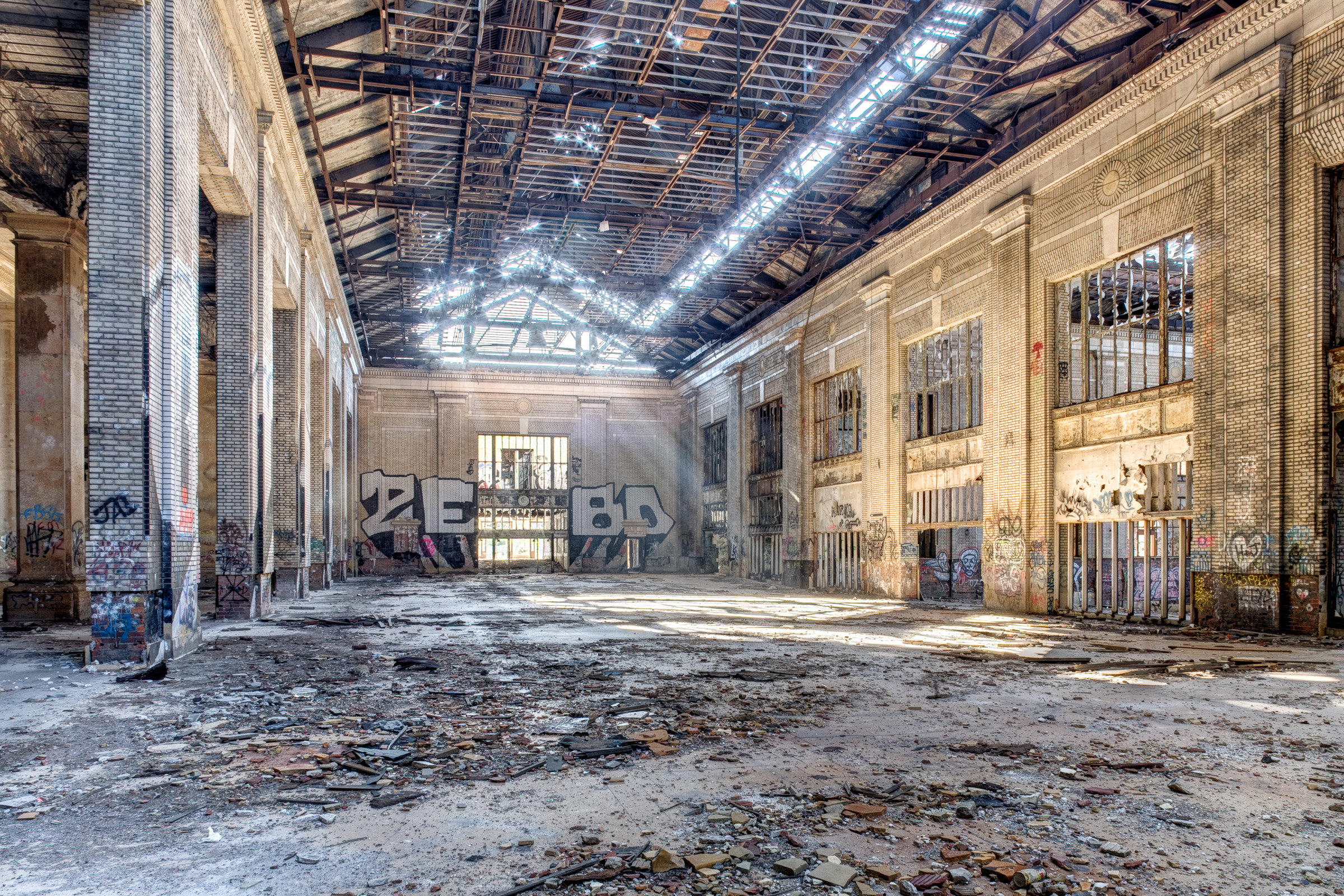
Holubow's signature approach involves the stitching of multiple high-resolution exposures into large-format panoramic composites — images that capture entire rooms, entire facades, entire landscapes in a single, navigable frame. Where a conventional photograph selects and excludes, the panoramic composite includes: it gives the viewer the spatial experience of actually being inside the space.

The technique demands extraordinary patience. A single image may involve dozens of exposures stitched together, corrected for parallax and exposure variation, and resolved at resolutions that reward extended examination at large print sizes. Details invisible in a thumbnail — a date scratched into a wall, a name written on a locker door, a piece of equipment whose function requires research to understand — emerge only when the viewer leans in.

This is intentional. Holubow wants people to spend time with his photographs. "I want people to spend time scanning the scene and noticing different aspects that they didn't see before," he has explained. "The panoramic technique gives a much larger resolution image at a larger vantage point, so viewers can really scour the whole scene in a more detailed and immersive, controlled manner."

"I'm trying to capture the character of a scene. To figure out something to say about the building or its inhabitants. There should be some kind of takeaway beyond just — this used to be a former factory."
Eric Holubow  ·  Whitewall Magazine
Exhibitions & Publications
2024
Abandoned: America's Vanishing Landscape — Second Edition
Schiffer Publishing · National & International Release
Publication
2015
A. Lange & Söhne Boutique — 785 Madison Avenue
New York, NY · Curated by Hexton Gallery · Six Photographs
Solo Exhibition
2014
Art Southampton
Southampton, New York · Book signing & exhibition
Art Fair
2012
In Decay: Stitching America's Ruins
Chicago Cultural Center · Chicago, Illinois
Solo Exhibition
2012
Abandoned: America's Vanishing Landscape — First Edition
Schiffer Publishing · National Release
Publication
2012
CBS Nightly News with Scott Pelley
"Photographer Captures Beauty in Forgotten Landmarks" · National Broadcast
Broadcast

Own the work.

Limited edition fine art prints are available in sizes from small to large-format, in editions of 5 to 25. Each print is archival pigment on premium matte paper, signed and numbered by the artist.